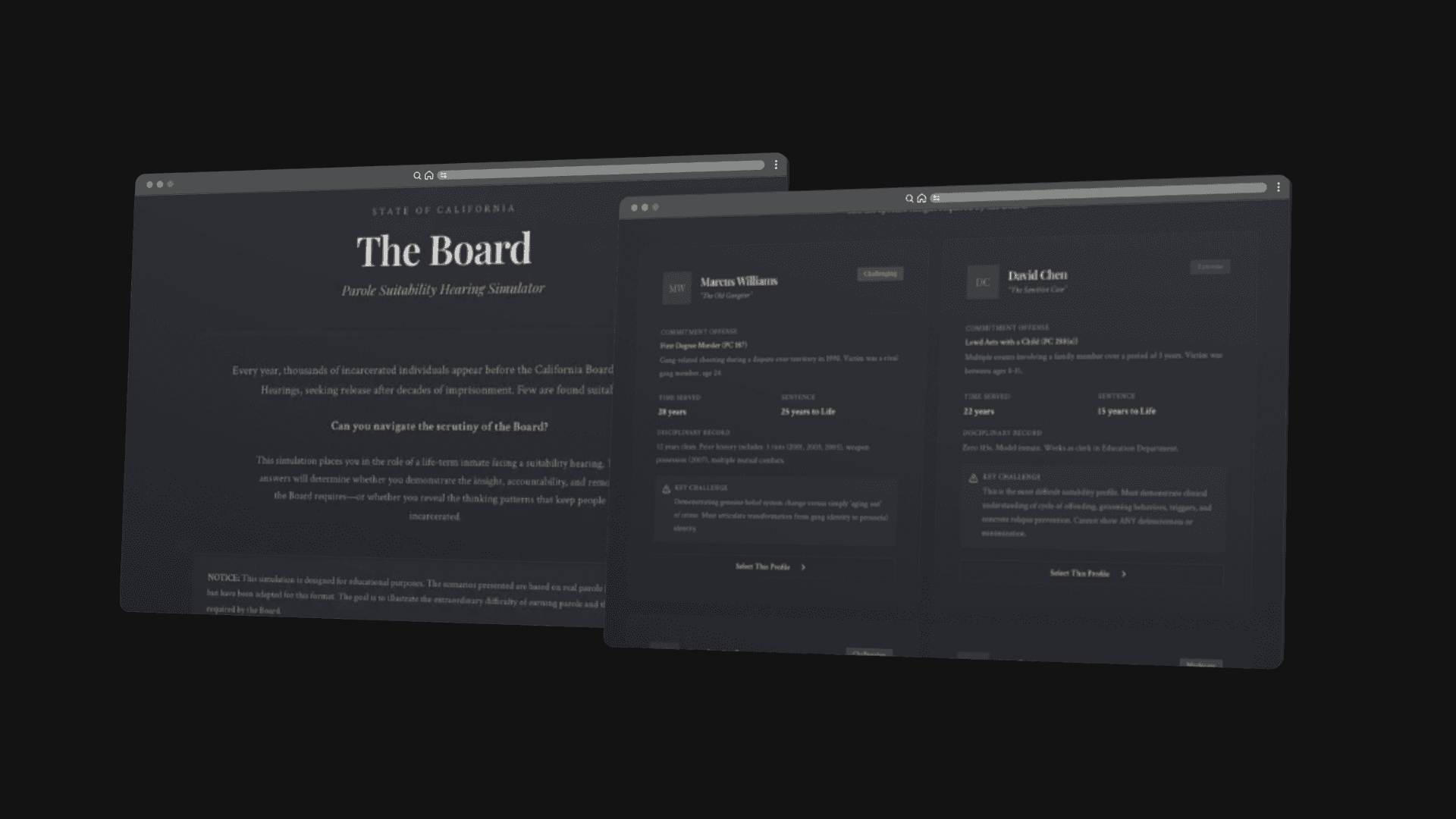
An immersive, institutional-grade civic literacy simulation designed to place users in the high-stakes role of an incarcerated person navigating the rigorous legal and psychological structures of a parole board hearing.
Client
CAtegory
ARTIST
Product Duration
ABOUT
The Board — A Civic Literacy Simulation for Parole Suitability.
The Board is an immersive, institutional-grade simulation designed to educate users on the rigorous legal and psychological standards of the California Board of Parole Hearings (BPH). While the concept of parole is a common fixture in public discourse, the actual path to "suitability" is often an invisible and incredibly steep climb.
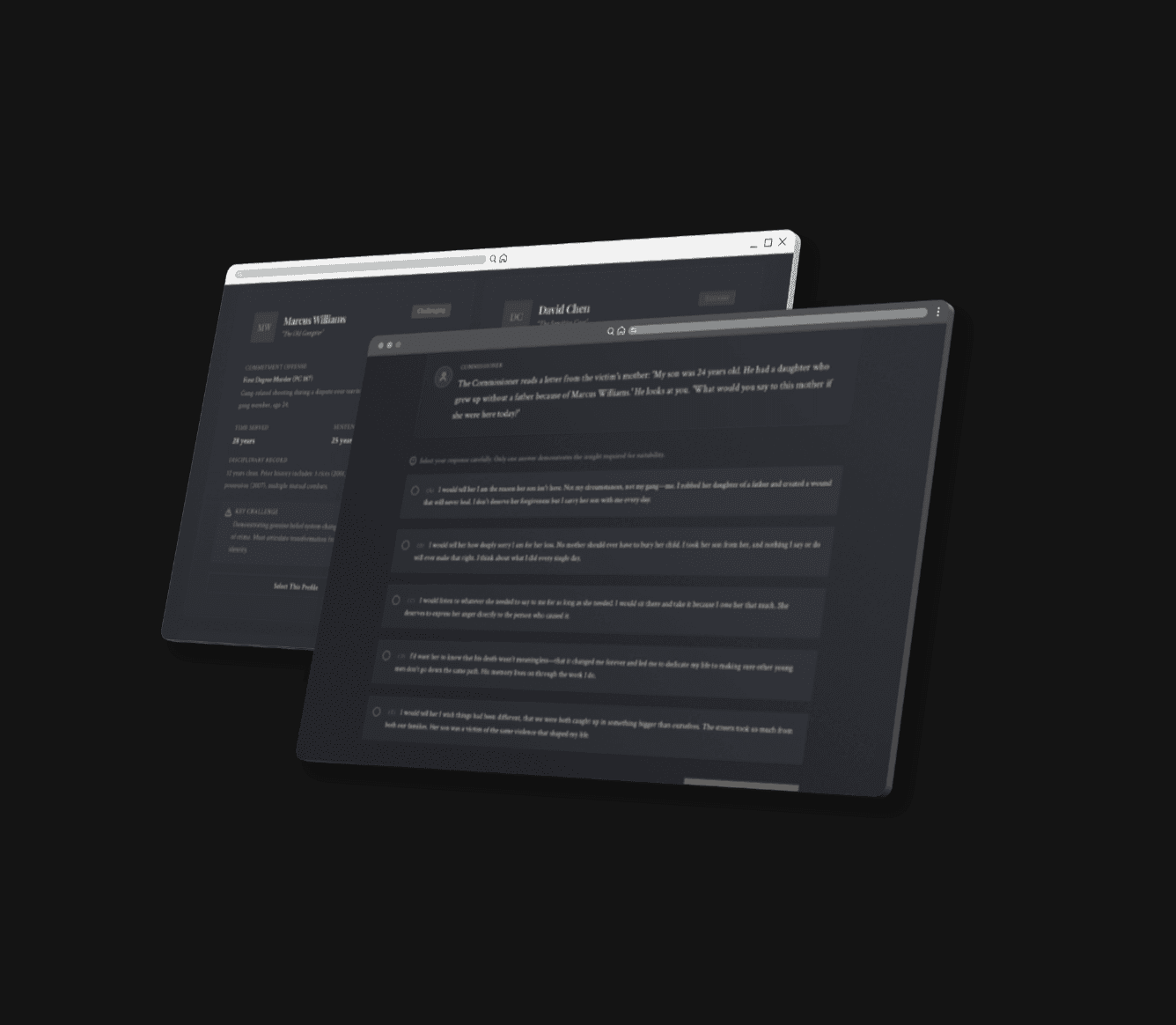
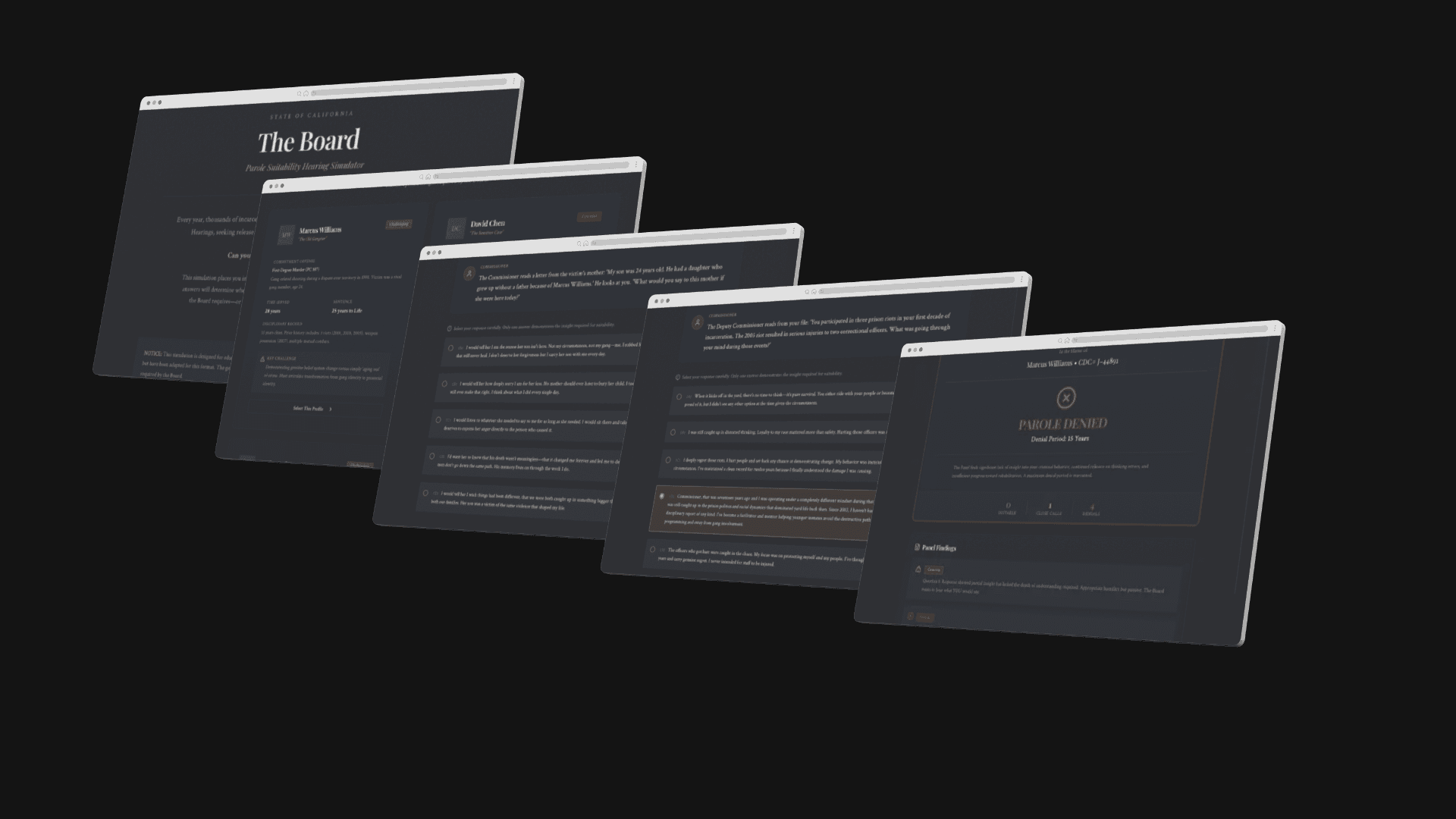
In this experience, the user is placed in the role of an incarcerated person appearing before the Board. Tasked with navigating nuanced, multi-dimensional profiles—such as a Three Striker or a complex "Murder-for-Hire" case—the user must answer a series of high-stakes inquiries that mirror the intensity of a real-world hearing. Built with a somber, high-contrast UI to reflect the gravity of the setting, the tool uses a robust scoring engine and randomized question pools to demonstrate the difficulty of earning parole. The goal is to shift the user’s mindset from passive observer to active participant, bridging the gap between public perception and the grueling reality of the judicial process through interactive, evidence-based storytelling.
THE CHALLENGE
Simulating the Burden of Proof.
The core challenge was to design a digital experience that forces users to feel the weight of their own words. In a BPH hearing, "suitability" is a high bar, and the consequences of a wrong answer are years—if not decades—of continued incarceration.
We navigated three primary design tensions:
The Empathy Gap (Simulation vs. Reality): How do you make a user feel the immense pressure of a parole board from behind a screen? The UI had to abandon standard "delightful" design patterns in favor of a heavy, institutional aesthetic that mimics the sterile and intimidating atmosphere of a state hearing room.
The Anti-Heuristic Barrier: Most digital quizzes can be "gamed" by looking for patterns in answer length or tone. To truly educate the user on the complexity of legal testimony, I had to engineer a system where the "correct" suitability answer couldn't be found through shortcuts. This required a deep data structure that intentionally varied linguistic patterns to ensure users were engaging with the content, not the interface.
The Accessibility of Complexity: The BPH process involves dense legal terminology and psychological assessments. The challenge was to distill these multi-dimensional inmate profiles into a readable, interactive format without stripping away the nuance or "dumbing down" the severity of the crimes or the rehabilitation requirements.
Ethical Data Minimalism: Given the sensitivity of the subject matter, the architecture had to be accessible yet private. I opted for a 100% client-side React architecture, ensuring that the complex logic and inmate data are handled without the need for a backend or database, facilitating easy deployment and total user privacy.
THE RESULTS
Results & Technical Validation
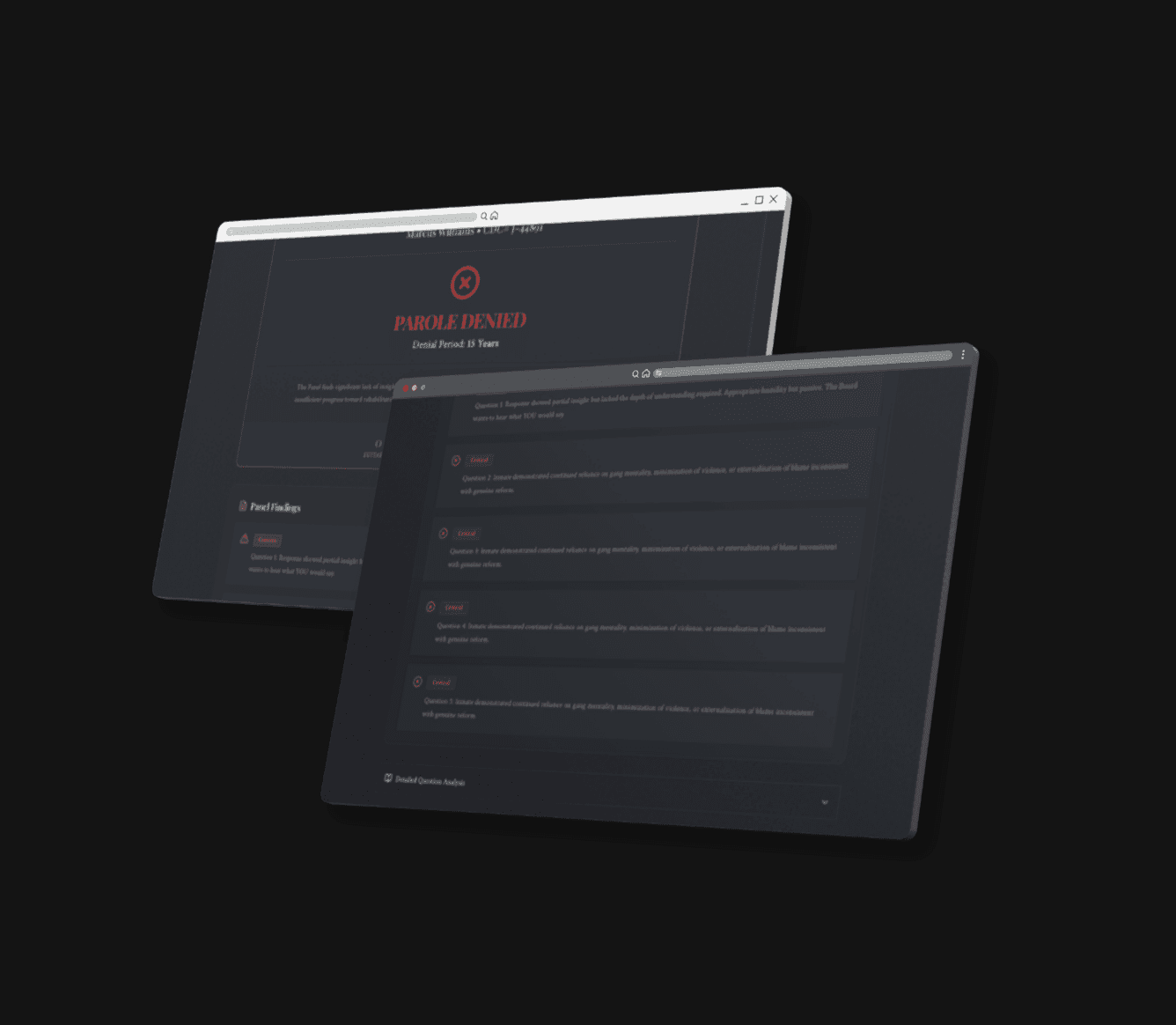
Institutional "Presence" Design System: Architected a somber, high-contrast UI using Tailwind CSS and shadcn/ui. By stripping away non-essential visual flair, the design creates a focused environment that prioritizes the gravity of the testimony, validating the power of "mood-first" product design.
Algorithmic Integrity Engine: Engineered a randomized question-logic system that pulls 5 distinct inquiries per session from a pool of 15. This ensures a unique experience for every "hearing," proving the platform’s utility as a repeatable learning tool for civic literacy.
Validated Heuristic Mitigation: Implemented a data layer where answer lengths and positions (A-E) are uniformly distributed and intentionally randomized. This technical choice successfully forced users to rely on reading comprehension and empathy rather than test-taking heuristics to pass the simulation.
Zero-Infrastructure Deployment: Developed a 100% client-side React architecture that manages complex scoring and branching narratives without a backend. This ensures total user privacy and extreme scalability, allowing the tool to be hosted on static platforms like Netlify while maintaining high performance.
Systemic Flexibility: Integrated a centralized configuration system for Get2 branding and hyperlinks. This demonstrated a "platform-first" approach, ensuring the app can be easily white-labeled or adapted for different advocacy or educational organizations in the future.
THE IMPACT
The Board establishes a benchmark for high-stakes narrative UX within the Get2 ecosystem. By transforming dense, invisible judicial processes into a deeply visceral digital simulation, it successfully demonstrates how intentional system design can break down institutional complexity and build profound structural empathy.

